Showing posts with label Hinkley news. Show all posts

Wednesday, November 6, 2013

Solar is the Viable Alternative Energy Solution to New Nuclear Plants

Ben Willis - Solar Power Portal | 
Wednesday, 30th October 2013

Mark Turner, operations director from Lightsource Renewable Energy, believes that solar can provide enough energy to match Hinkley C within two years. Here's why.

spv.jpg
Solar in the UK could deliver the same amount of electricity production as the proposed Hinkley Point C nuclear power station within two years, according to the country's largest PV generator.
In an open letter to Prime Minister David Cameron, Mark Turner, operations director at Lightsource Renewable Energy, said that solar was better positioned than Hinkley C, not scheduled to come online until 2023, to prevent imminent power blackouts predicted in the UK.
Turner acknowledged the value of Hinkley C to the UK's long-term energy security, but highlighted the much shorter term need to provide new generation capacity to replace coal-fired power stations due to be decommissioned soon. National regulator Ofgem has predicted an energy drought by 2015 as this happens.
He said solar was well positioned to provide this short-term need: "The solar sector in the UK is gaining traction and the experience in Germany and Italy has shown that the solar industry has the capability to deliver the same energy production as Hinkley Point C in less than two years and at a comparable cost."
Turner said the announcement of the £92.50, 35-year strike price announced for Hinkley C on Monday in the UK will 'shake investor confidence' in the role the government has to play in providing the "modest and declining support that this nascent business sector receives until it becomes fully self-sufficient".
He said solar would not offer the 'whole solution', but said that if its deployment was properly supported, within a couple of years it could supply up to 10% of the UK's energy mix 'completely free from the vagaries of the global fossil fuel markets'.
"This would then combine with the 9% from Hinkley Point C when it eventually comes on stream," Turner said. "We urge you to provide more education and resource to the nation regarding the true benefits of solar power technology and make the nation aware that we can take this whole matter into our own hands if we chose to."

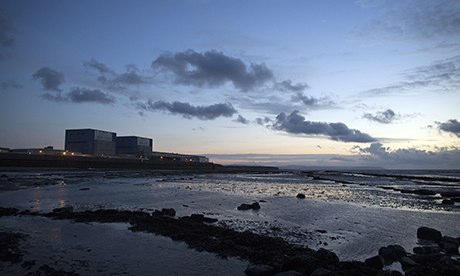
Thursday, October 31, 2013

Hinkley Point: nuclear power plant gamble worries economic analysts

Liberum Capital analysts flabbergasted by UK government's deal with EDF on nuclear power station
Hinkley Point
The government's deal with EDF will make Hinkley Point the most expensive power station with the longest construction period. Photograph: Bloomberg/Getty Images
The government's agreement to underwrite the Hinkley Point nuclear power station could turn out to be economically insane and hugely costly to consumers, City analysts have warned.
Analysts at Liberum Capital said the government's deal with France's EDF will make Hinkley Point the most expensive power station in the world with the longest construction period in the world.
The government gave the go-ahead last week for EDF to build the Hinkley Point C plant in Somerset. Its two reactors will cost £8bn each and will provide power for about 60 years once it starts operating in 2023.
The energy secretary, Ed Davey, has made a huge bet that fossil fuel prices will rocket by the time Hinkley Point starts operating in 2013, Liberum's Peter Atherton and Mulu Sun said in a report published on Wednesday.
They said: "The UK government is taking a massive bet that fossil fuel prices will be extremely high in the future. If that bet proves to be wrong then this contract will look economically insane when HPC commissions. We are frankly staggered that the UK government thinks it is appropriate to take such a bet and underwrite the economics of any power station that costs £5m per MW and takes nine years to build."

Saturday, October 26, 2013

Industry could build solar equivalent of Hinkley in two years, firm tells PM

Photo: Activ Solar via Flickr

Solar power technology could deliver the same levels of electricity as the planned nuclear plant at Hinkley Point, at a similar cost and in just two years – rather than the decade it will take for the power station to come online.

In a letter to David Cameron, Mark Turner, operations director at solar power firm Lightsource Renewable Energy, says that an increased and immediate rollout of solar could help avoid the predicted power shortages that the regulator Ofgem expects the UK to suffer by 2015. This is when a number of coal-fired power stations are set to be retired.
A deal to build another nuclear power station at Hinkley Point in Somerset – the first new nuclear plant in the UK in 25 years – was confirmed on Monday. However, the plant is not expected to begin generating electricity until 2023, which Turner says doesn’t solve the problem of blackouts.

Solar can ‘outshine Hinkley’

Solar can ‘outshine Hinkley’ image
Lightsource has written to Prime Minister David Cameron to claim that the UK solar industry can deliver the output of Hinkley Point C within two years.
The open letter states that the nuclear power station in Somerset will “only be of use in 10 years’ time at the earliest” and better options are available in the face of an Ofgem-predicted energy drought in 2015.
PV, it asserts, can provide “energy security quickly, reduce electricity bills and protect the environment” as well as having the “capability to deliver the same energy production as Hinkley Point C in less than two years and at a comparable cost”.
Lightsource operations director Mark Turner writes: “To avoid the ever-increasing risk of blackouts, £110bn needs to be spent replacing the 20% of the UK’s (coal-fired) capacity scheduled to be turned off by 2018.
“Whilst the announcement of Hinkley Point C will make a material contribution to plugging the gap without further perpetuating our dependency on fossil fuels, this new power station will only be of use in 10 years’ time at the earliest.
“We must act to protect consumers from energy prices that have risen by over 25% since 2009.