Showing posts with label Clean Energy. Show all posts

Monday, November 18, 2013

Business Forum: Nuclear power is not 'clean energy'

  • Article by: JOHNNY JOHNSON 
  • Updated: November 17, 2013 - 1:50 PM
Before taking expansion of nuclear power seriously, the country needs to deal with the unresolved issue of radioactive waste storage.When he announced his climate action plan this summer, President Obama said we have “a moral obligation to leave our children a planet that’s not polluted or damaged” and that by taking “responsible steps to cut carbon pollution,” we can “leave a cleaner, more stable environment for future generations.”
To anyone concerned about our energy policy and our planet, the president’s plan could be a promising sign. But for the Prairie Island Indian Community, we found his words advocating an “all-of-the-above approach to develop homegrown energy” disconcerting. And this month’s announcement of a new presidential adviser to implement the climate action plan did little to assuage our fears.
Let me tell you why. As ­Mdewakanton Dakota, we use the term “seven generations” to refer to a length of time — and the successive generations of our people who can be affected by our actions today. So while we applaud and support the goal to leave our future generations a cleaner, more stable environment, we disagree with the president and the growing chorus from the pro-nuclear lobby who say that increased nuclear power is the pathway to cleaner energy security.
To be clear, the Prairie Island Indian Community is not opposed to nuclear power as an energy source. We are, however, deeply troubled by any implication that it represents clean energy. Indeed, the nuclear industry has generated a reported 67,500 metric tons of highly radioactive waste, against which the earth and its inhabitants must be shielded for hundreds of thousands of years.

Monday, February 18, 2013


Electricity emissions fall as coal sidelined by renewables


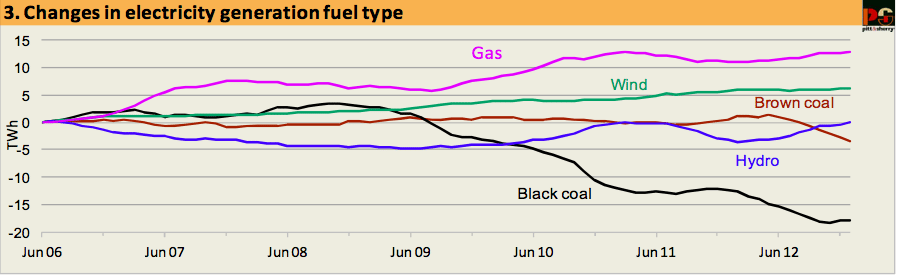
In its latest assessment of Australian electricity production and emissions, consulting group Pitt&Sherry said even production from highly polluting brown coal generators has fallen in the past 12 months. Part of this was due to floods at the Yallourn mine in June,Emissions from Australia’s National Electricity Market (NEM) have fallen to 10 year lows, as demand continues to ease and the amount of coal reduction falls because of the growth of renewable energy, which has reached its highest levels since the 1980s.

The report notes that a 500MW unit at the Wallerawang C power station near Lithgow in NSW has also been mothballed, for at least 12 months, as a result of the changing dynamics of the NEM. This adds to the near 3,000MW of coal-fired capacity put on hold in the past year.
The latest data (illustrated in the graph below) shows that gas, hydro and wind generators have all increased output, with the Tasmanian hydro system reaching its highest level since joining the NEM in 2005, taking total hydro electricity production to it highest levels since 2000-01.
Screen Shot 2013-02-13 at 11.07.17 AM
Wind energy generation fell slightly in January from December, but Pitt&Sherry said the commissioning of the 420MW Macarthur wind farm in Victoria would push wind output to its highest levels in the next month or so.
Gas generation also reached its highest ever annualized levels in January. “These are precisely the changes in the electricity supply mix which the carbon price would be expected to induce,” the report said.
Total renewables (hydro plus wind) reached 12.1 per cent of NEM generation in the year to January 2013. This is the highest share of renewable supply in what is now the NEM since the 1980s, when total demand for electricity was less than 60 per cent of its current level.
“This fact highlights that the growing share of electricity supplied by low emission generators in the NEM, and the corresponding fall in average emissions intensity of total NEM generation to its lowest ever level, is due as much to the fall in demand for electricity from the NEM as to the increased output from low emission generators themselves,” the report said.
“Had demand kept growing at the rates seen up to the end of 2006, the shares of gas, hydro and wind generation would have been significantly lower, for the same total output, and the emissions intensity of NEM generation higher. “
The report notes that the biggest falls in demand have occurred in NSW and Victoria, with demand in SA and Tasmania virtually unchanged for more than four years.

Wednesday, February 6, 2013


More Cleantech News!

I’ve got a ton more cleantech stories for you from around the cleantech interwebs this week. I’m going to try a simpler and quicker approach this time by just placing the titles and links alone without any excerpt or summary. Let me know how you like this? Like it more than with the summaries? Prefer having the summaries? Don’t really care?

Solar

Wind


Clean Technica (http://s.tt/1dArU)
Read more at http://cleantechnica.com/2012/06/07/more-cleantech-news/#Iq3yqcDzk47cwkEg.99 

Read more at http://cleantechnica.com/2012/06/07/more-cleantech-news/#Iq3yqcDzk47cwkEg.99 

Friday, December 28, 2012


Green energy’s future rosy, industry officials say

Sean Moore is CEO of Unconquered Sun Solar Technologies, which expanded to include solar-powered golf carts. The company is retrofitting golf carts, installing a solar panel on the roof. (DAN JANISSE/The Windsor Star)Sean Moore is CEO of Unconquered Sun Solar Technologies, which expanded to include solar-powered golf carts. The company is retrofitting golf carts, installing a solar panel on the roof. (DAN JANISSE/The Windsor Star)
While the government reviewed the Green Energy Act over the past 18 months, it issued no new feed-in-tariff contracts. Some solar panel factories lured to the region went out of business, while others trimmed staff.
The province released changes to the Green Energy Act this summer that created a competition system for FIT projects. Higher priority is given to municipally supported proposals, while solar installations on the roofs of public buildings are favoured over private facilities. The law now restricts ground-mounted solar projects near residential areas and reduced the amount paid to green electricity producers.
Wind projects are subject to the same competition system and while communities can’t kill a development, they can deny it support, which hurts it in the competition evaluated on a point system. Points are given to projects if they meet certain criteria like having community support or use of a public building.
The green energy industry is trying to work out the kinks and figure out how to survive. Unconquered Sun owner Sean Moore rode out the lows of the green energy business by creating new products like a solar-powered golf cart and adjusting to new regulations. When the province created the competition system for solar FIT contracts, Unconquered Sun, which manufacturers solar panels, altered its plans.

Monday, November 26, 2012


Entire cities could run on compressed air

by Tina Casey

The company LightSail Energy started out a few years ago with a student’s modest idea for a compressed air scooter, and now it has just raised $37.3 million in private funding to bring utility scale, compressed air energy storage to the market. That’s a big leap not only for the company but for compressed air technology itself, which has long been eyed for its clean energy potential. The problem has been to make the process efficient enough to deliver power at a commercial scale, so let’s take a look and see how LightSail solved the problem.
The Compressed Air Conundrum
As aptly described by writer Rachel Metz over at the MIT Technology Review, half of the compressed-air equation is simple enough from a clean energy perspective. You can use any form of alternative energy such as solar or wind to generate electricity, which in turn powers a motor that compresses air in a tank.
The  hard part kicks in when you try to store large quantities of compressed air. Compression adds energy in the form of heat (almost 1,000 degrees centigrade, according to Metz) and that leads to enormous complications.
The Indian car manufacturer Tata Motors has apparently found at least a partial solution for small scale compressed air, but LightSail is going down an entirely different road.
LightSail’s Compressed Air Solution
Danielle Fong, Chief Scientist and co-founder of LightSail, is the former student who dreamed of a compressed-air scooter. She solved part of the problem by designing two related features into the system. One involves using mist to cool the air, and the other involves recapturing energy from the spent mist, in the form of heat.
According to Metz, Fong and her partners also identified a compound that could be used to manufacture tanks strong enough to store bulk quantities of compressed air above ground, in relatively inexpensive facilities, leading to the conclusion that “there are no technical barriers to building units large enough to power entire cities.”

Wednesday, November 7, 2012


It’s Obama! Now what for climate change and clean energy?

by Alden Meyer

After months of speeches and debates, and billions of dollars of campaign ads, the elections are over and President Obama has won a second term in office. Now comes the hard part: how to move forward in a polarized political environment where the two major parties don”t agree on the overall role of government, on most policies, and all too often, not even on the facts.
One big unknown is how Republican leaders will respond to the president’s re-election victory.  In October of 2010, Senate Republican Leader Mitch McConnell  said ”the single most important thing we want to achieve is for President Obama to be a one-term president.”  With that goal no longer an option, will Senator McConnell and his fellow Republican Senators be more open to compromise with the president?  Or will they be looking over their right shoulders at possible Tea Party primary challengers like those who took out Dick Lugar this year and Mike Castle in 2010 (Richard Mourdock and Christine O’Donnell. respectively, both of whom lost in the general election)?  Similarly, with a continuing solid margin of control in the House and a structural advantage because of redistricting in the 2014 elections and beyond, will Speaker Boehner and other House Republican leaders be inclined (and able) to reach deals with a Democratic president and Senate, or are we fated to ever more polarization and gridlock? With the looming fiscal cliff negotiations over taxes, spending, and the debt ceiling, we’ll have the answers to these questions fairly soon.
The president’s science agenda

Friday, October 26, 2012


Energy from waste: A clean energy source that’s building steam

by Sophie Vorrath

While the trends are varied across individual countries, significant progress continues to be made globally in the deployment of renewable energy and energy efficiency measures. We thought it timely to provide an insight into certain lesser-known clean energy sectors. One such area is the Energy from Waste (EfW) sector.
We find the Energy from Waste sector fascinating. It involves the incineration of waste to create electricity, steam or heat. It is very well developed in certain northern European countries, showing it is a proven and viable source of renewable energy. In Germany, some 32% of all waste is processed in Energy from Waste facilities, while Denmark is a world leader at 51%. In America, industry estimates put EfW share at a relatively low 7% of waste disposal. What are the attractions of Energy from Waste?
– It is a source of baseload renewable energy with availability factors consistently in-excess of 90% pa (higher than coal at c. 80%!).
– EfW incineration dramatically reduces landfill and can work very effectively in conjunction with waste recycling programs (for example paper, plastics and metals).
–For every 10 tonnes of landfill waste diverted to EfW, 9 tonnes of carbon dioxide emissions are avoided.
– The annuity style revenue associated with waste disposal and electricity generation is well suited to public-private partnerships.
– The rapid urbanisation of China and India and lack of landfill capacity means there is a huge need and opportunity for the development of EfW projects.
Covanta Holdings (NYSE listed) is a world leader in the EfW sector. With a sole focus on EfW, Covanta is significantly smaller than its key global rivals, the more diverse Waste Management in North America and Veolia Environment in Europe,, but has the added bonus of electricity and steam generation. The Covanta model is premised on being paid to take waste and also being paid to generate renewable, baseload electricity. Covanta operates 43 facilities across North America, two in China and one in Italy. Covanta has a current market capitalisation of US$2.3 billion and is 11% owned by interests associated with Sam Zell, a US property billionaire.
Covanta operates facilities that generate over 10 million MWh (megawatt hours) annually, the equivalent to 1,300 MW of generation capacity with an average availability of over 90%. Covanta estimates it holds a 65% share of the American Energy from Waste sector. Add to EfW their other renewable energy facilities and Covanta represents 8% of all US non-hydro renewable energy production.

Wednesday, September 19, 2012


Germany leads booming global cleantech market

by Cleantechnica

By Nathan
Worldwide, the clean technology market is worth more than €2 trillion a year, and it is expected to more than double in size by the mid 2020s, according to new research commissioned by the German government. This doubling of market size is expected to occur regardless of potential ongoing global financial turmoil.
Specifically, the research found that the clean technology market has “grown at an average of almost 12 per cent a year since 2007, and predicts it will continue to accelerate over the coming years.”
“The economic and financial crisis has not stopped the worldwide expansion of the green tech industry,” said the study’s author, Torsten Henzelmann, head of the Civil Economics, Energy & Infrastructure Competence Centre at Roland Berger Strategy Consultants. “On the contrary, the worldwide market volume has now overshot the €2tr mark, thus exceeding our forecasts from 2009.
“Things will be a bit slower than in previous years, but by 2025 we expect the worldwide market to double in value to €4.4tr.”
The research also revealed that Germany has a dominant share of the global clean tech market, at 15%, and is expected to grow more than any of its competitors. Germany’s cleantech companies are already generating a very high 11% of the country’s GDP and employing over 1.4 million workers. And according to the research, the clean tech market volume is expected to reach €674 billion by 2025, more than doubling.
Germany’s success is only attributable to its very clear vision and “guarantees [of] investment security.” Though its “early-mover advantage” helped that, it isn’t the main reason for its success, said Luc Bas, the director of European programmes and international states and regions at The Climate Group.

Wednesday, September 12, 2012


Germany's Clean-Technology Industry to More Than Double by 2025

By Stefan Nicola, Bloomberg
11 September 2012  
 

Tuesday, August 14, 2012


World at tipping point for new era of clean energy

by Tim Flannery

1. Taking the long view it is clear that we have come an enormous way in 10 years in tackling climate change.
 When I wrote the Weather Makers there was very little public awareness of climate change. However, since 2006 climate change has dominated Australian media and political debate.
 A decade ago there was little business and government activity. Today the Federal government has introduced the Clean Energy Legislation, polluters are now paying for their pollution, a new industry coalition of 330 companies has been created to hasten action, and more people than ever are shifting to clean energy.
 We are taking early steps on a multi-decade pathway to transform our economy and society. There is an analogy to be drawn with the process of building Europe’s cathedrals. Those stunning buildings required long-term thinking, vision and leadership. Similarly we are building a new energy economy and it will take decades. But it will provide our children and grandchildren with a better future.
2. There is still more to be done, but it's heartening to know that wherever the Climate Commission has visited there has been a real thirst for action.
 Wherever the Climate Commission has travelled around Australia we have heard that Australians have a passion for renewable energy. We have also heard that there is a real desire from Australians to contribute and do their bit.
 What we’ve noticed is that Australians are quietly getting on with it. They are using energy smarter in their businesses and homes and they are installing solar panels and more efficient appliances amongst other things. We’ve been impressed with the capacity of Australians to come together, at school, at work and in the community to use their ingenuity to find solutions that are good for the environment and reduce costs.

Monday, July 30, 2012


Five things we learned from… Clean Energy Week

by Giles Parkinson

The principal theme of the Clean Energy Week conference in Sydney was the protection of the Renewable Energy Target. At first blush, that was achieved, with each of the major parties declaring their support. But support for what, exactly? The question lingers as to whether that was 41,00 gigawatt hours of renewable energy inscribed in the legislation, to add to the 15,000GWh of mostly hydro that was built previously, or a notional percentage that is being pushed for by some parties.
Climate Change Minister Combet said it was the legislation he was defending, but despite numerous prompts couldn’t bring himself to say the words "41,000." Coalition energy spokesman Ian Macfarlane was more evasive, saying only 20 per cent, but wouldn’t say 20 per cent of what.
For many at the conference, this left lingering concerns that the RET could yet be tampered with. The fixed target has already been reduced once to account for larger than expected deployment of rooftop solar. Could that happen again? Would the demand equation come into play?
Some wondered why the clean energy industry doesn’t take a leaf out of the mining and the high emitting industries and push aggressively for an even higher target. That could serve two purposes – to develop a longer-term narrative about a clean energy future (after all, the move to decarbonisation does not stop in 2020), rather than being defensive about a policy which is being painted  in many quarters as expensive and pointless. And to give them negotiating room to manoeuvre. Perhaps what the industry needs is a Mitch Hooke-type character scaring the daylights out of Australians on the prospects for the country if it did not embrace wind and solar.

Friday, July 20, 2012


In Episode 69 of The Wendel Forum (originally aired on July 7, 2012, on 960 KNEW AM radio), show moderatorDick Lyons, co-founder of Wendel Rosen’s sustainable business practice group, welcomes Gary Price, a tax partner at Sensiba San Filippo, one of the Bay Area’s largest accounting firms and a green business certified under the Bay Area Green Business Program
Gary Price
Dick and Price discuss how in the last few years, it’s become economical for businesses to use renewable energy sources, particularly solar and wind, which provide energy without using oil or gas. Because buildings and their occupants produce a significant amount of pollution, even  businesses like accounting, law and other service firms can help the environment by buying clean energy from roof-mounted solar power systems that replace or supplement power from the grid. Even if those businesses occupy just one floor of a big building, they can contribute to lower energy consumption.
Renewable energy used to cost more than electricity purchased from utility companies.  But the 2008 renewable energy credit program helped bring prices down.  Within just four or five years, companies using renewable energy will see the payback, resulting in real cash savings. Using solar and wind energy also has related insurance and bank loan benefits.

Friday, June 22, 2012


Getting Natural Gas, Solar, and Wind to Play Well Together

Natural gas shouldn’t feel threatened by solar or wind. Solar and wind shouldn’t feel threatened by natural gas.

HERMAN K. TRABISH: JUNE 21, 2012
Increasing levels of solar and wind in the power production system need to be firmed by natural gas.
The Renewables Electricity Futures Study, a new comprehensive report from the National Renewable Energy Laboratory, concluded that “variable generation levels of up to nearly 50% of annual electricity can be accommodated when a broad portfolio of supply- and demand-side flexibility resources is available at a level substantially higher than in today’s electricity system” and that broad portfolio should include “sufficient capacity on the system for planning reserves” and “demand-side interruptible load, conventional generators (particularly natural gas generators), and storage.”
What is unknown is how current, unprecedentedly low natural gas prices will affect the growth of solar and wind.
Erik J.A. Swenson, a partner in the Washington law firm of Fulbright & Jaworski, presented on U.S. natural gas policy at the recent American Wind Energy Association (AWEA) annual conference and argued that making the export of liquid natural gas (LNG) easier will drive the market price up and grow solar and wind.
In full disclosure, Swenson acknowledged that Fulbright represents clients that want to export LNG.
“Wind and solar combined with natural gas present a good combination of greenness and cost,” Swenson said. “Wind and solar are intermittent sources of generation and gas is the natural firmer.”

Move Over, Solar: Lesser-Known Clean Energy Technologies Poised for a Surge in the Decade Ahead 

Published: Thursday, Jun. 21, 2012 - 10:17 am
/PRNewswire-iReach/ -- For most people, the term "Clean Energy": brings to mind images ofwind turbines and solar photovoltaic panels, but these represent just a small portion of availableclean energy technologies. Global Information is pleased to provide two excellent new reports that focus on lesser-known but high-potential sources of environment-friendly power: Biogas and Biopellets. Premium market research reports like these help businesses stay on the cutting edge with the best forecasts, research, and analyses.
Biogas is a resource captured as a byproduct of municipal solid waste processing (MSW), as well as agriculture, industrial, and sewage treatment.  Growing demand for such waste treatment processes creates similar growing opportunity to develop this source of energy. The use of bio-digesters to process manure and crop residues in Germany, for example, has demonstrated the potential for rapid deployment of biogas capture on a distributed basis.
The global biogas industry still faces significant barriers, however, as lower natural gas prices,challenging economics, and project-to-project variability frustrate efforts to achieve economies of scale. As of 2012, biogas production accounted for only a fraction of natural gas production with bio-digester deployments concentrated primarily in Germany and landfill gas recovery confined mostly to advanced economies throughout North America and Europe.
Pike Research's new Renewable Biogas Market Analysis and Forecast offers worldwide revenue and capacity forecasts for raw biogas and RNG production. This report also looks at demand drivers, business models, policy factors, and technology issues.

Read more here: http://www.sacbee.com/2012/06/21/4579337/move-over-solar-lesser-known-clean.html#storylink=cpy

Could Portugal ever run entirely on green energy again?

Peniche coastlineThe waters off the coast of Peniche are home to Portugal's latest green initiative


Portugal is a world leader in renewable energy. More than half its energy comes from wind, solar and hydro power. But as the country struggles through a record recession will their sustainability drive ground to a halt?
For a few glorious hours at the end of 2011, Portugal's entire energy needs were met by renewable sources of energy.
They have the world's largest solar farm, Europe's largest wind farm and extensive hydro-electric dam infrastructure.
And in the Atlantic waters off the coast of Peniche, 62 miles (100km) north of Lisbon, scientists hope to achieve another first in sustainability.
Finnish energy company AW Energy is days from fixing its WaveRoller machine to the ocean floor.
Three fibreglass panels, 100 sq m (1,076 sq ft) each in size, will swing back and forth with the motion of the waves on hinges attached to control stations anchored to the ocean floor.

Friday, May 18, 2012


How Brazil is emerging as a global clean energy leader

by Tim Buckley

In world-leading economies such as China, Germany, India and the US, huge investments are being made to position for a low-carbon future. The rationale behind this investment includes the benefits of improved energy security, stronger trade balances, growth in employment and industry leadership, plus the associated environmental gains. In this article, we look at the massive expansion and modernisation of the energy sector in Brazil.
Why is Brazil intriguing?
– Brazil is the 10th largest country in the world in terms of electricity generation;
– In contrast to the very subdued economic growth globally, Brazil continues to grow GDP in excess of 5% annually (clearly holding its own among the four BRIC nations);
– Electricity demand is forecast to grow at +5 per cent annually through to 2020. This means that 5-7GW of new generating capacity will be required each year, putting Brazil behind only China and India in terms of global net new electricity capacity additions;