Showing posts with label Energy storage. Show all posts

Tuesday, December 30, 2014

Graphene Could Kill Lithium-Ion Batteries


December 29th, 2014 by 

Don’t break out the widow’s weeds just yet, but it looks like momentum is building for energy storage to move past the lithium-ion phase and get into the more powerful territory of lithium-sulfur technology. In the latest development, a multinational research team has figured out how to overcome a major obstacle in the path of lithium-sulfur energy storage, by using graphene as a “bridge” between different components.
In theory, lithium sulfur (Li-S) batteries possess far greater energy density than the familiar lithium-ion (Li-ion), so breaking the technology out of the lab and into commercial development could have huge clean tech implications for EV battery range and energy storage for solar and wind sources, among other applications.
graphene Li S energy storage
Schematic of 3-D hierarchically structured graphene-sulfur/carbonZIF8-D composite ( by K.Xi/Cambridge viaalphagalileo.org).

Lithium-Sulfur Energy Storage

Sulfur is super-cheap, which is mainly why researchers are interested in developing energy storage devices incorporating the material.
Sulfur also has some bonus attributes compared to conventional Li-ion battery technology, such as a high tolerance for overcharging, relatively light weight, and low toxicity.

Thursday, August 14, 2014

The economics of residential battery storage in Australia


Wednesday’s story about the rapidly approaching status of socket parity for solar and battery storage sparked a lot of interest, and a bunch of email requests asking for more information.
That story pointed out that if Brisbane-based Redflow could increase the number of cycles in its zinc-bromine flow batteries, it could be cost competitive with the grid within a few years.
redflowHere’s some more information from the report from Australian broking house Morgans. The table below is instructive because it includes the estimated capital cost of the storage system, plus the integrated systems manager. It notes that at its current cycles capability of just 1,000, the technology costs $1.29/kWh – effectively pricing it out of the market.
But that cost is lowered by half if the number of cycles is doubled. If the cycles can be increased to 3,500, and the kWh of storage increased from 8 to 10, then the cost of the technology falls to just 29c/kWh.
That, says Morgans, is very possible. And it means that the technology will be competitive with the grid.
“If Solar currently costs 10-12c (unsubsidised) then Australian energy storage will not be competitive with average grid prices any time soon. However with storage costs of ~30c there could still be a commercial case for peak shifting,” Morgans notes.
Without that increase in cycles, and peak pricing, the short term the economics of using a ZBM in conjunction with renewables at a household level in Australia doesn’t look compelling.
“For ethically or environmentally motivated individuals the ZBM is still an option, just don’t do the maths. The other alternatives that looks more likely over time is for the use of ZBM’s for peak shaving (i.e. versus expensive peak rates rather than average grid rates) and for off-grid or remote locations.”

Friday, August 8, 2014

Grid Battery Storage: Four Reasons to Invest

The emerging battery storage market will present new opportunities for investors.


Think of a product — chances are that Hawaii has to import it. From food and cars to electronics and building materials, there are few areas where the U.S. state is self-sufficient — and energy is no different.

Big Batteries Are Starting to Boost the Electric Grid - MyArkLaMiss.com - KTVE NBC 10 - KARD FOX 14 - Your homepage for the latest News, Weather and Sports in the ArkLaMiss!

Big Batteries Are Starting to Boost the Electric Grid - MyArkLaMiss.com -


(NBC News) -- Long hailed as a game changer that will allow unlimited amounts of wind and solar energy onto the electric power grid, big rechargeable batteries are beginning to move out of research labs and find a home amid the real-world tangle of smokestacks, turbines and power lines. Today, the reality falls short of the hype about fossil-fuel-free electricity — but experts say that future could be in store.
For the foreseeable future, electric utilities will rely on coal, gas and nuclear power plants to provide a steady base of power, according to Paul Denholm, a senior analyst at the National Renewable Energy Laboratory in Golden, Colorado. But batteries can help balance the flow of electricity as demand ramps up and down throughout the day.
"That is where the hot applications are right now for energy storage," he told NBC News.
Traditionally, utilities maintain a little "wiggle room" on their system, he explained. For example, they might run power plants at 90 percent capacity, so that extra juice can be made available when a dark cloud passes overhead and thousands of people flick on their lights.
Operating power plants that way is hard on a system. It's inefficient, and expensive. Batteries, which can add extra juice nearly instantaneously, are a more cost-efficient way to keep the grid humming. What's more, this load leveling usually only requires 15 to 30 minutes' worth of energy. "You can have a relatively small storage device and make a decent amount of money on it," Denholm said.
While the market for this type of battery usage is limited, it is an entry point for a technology in need of experience on the grid, he explained.
Load leveling is precisely what Avista Corp. in the Pacific Northwest plans to do with the 3.6-megawatt capacity vanadium flow battery it is purchasing for its grid in Pullman, Washington, with the help of a $3.2 million matching grant it received in July from Washington state to advance energy storage technology.
In theory, the battery from Mukilteo, Wash.,-based UniEnergy Technologies could be installed next to a wind farm to store excess generated electricity, for occasions when wind speeds go so high that turbines are shut down to prevent damage, or when the wind suddenly dies out.
"But that carries with it a lot of cost [for] a single purpose … and you still have to send it across the transmission lines to get it to the load," Curt Kirkeby, a senior electrical engineer and technical strategist with Avista in Spokane, Washington, told NBC News.
Rows of battery racks are arrayed at Portland General Electric’s Salem Smart Power Center in Salem, Ore. PGE is a participant in the Pacific Northwest Smart Grid Demonstration Project, which is using the center’s 5-megawatt energy storage system to test smart-grid strategies.

Wednesday, August 6, 2014

Sodium-β batteries could transform wind and solar into baseload generators : Renew Economy

The cost of generating wind and solar power has been sinking like a stone, but the cost of storing all that energy for a rainy day has remained stubbornly high. With that in mind let’s take a look at a new advanced energy storage development announced by our friends over at Pacific Northwest National Laboratory.
PNNL has been working on bringing down the cost of sodium-β batteries (that’s β for beta). Sodium-β batteries are widely perceived to be the key to advanced energy storage for utility scale wind and solar energy power, but their relatively high cost has been an obstacle to widespread adoption.
low-cost-energy-storage-e1407151368764
New liquid metal alloy improves sodium-β batteries (courtesy of PNNL).
Sodium-β Batteries For Advanced Energy Storage
Sodium-β refers to a class of rechargeable metallic batteries, in which the two electrodes are separated by a ceramic membrane made of beta alumina. Initially used to construct industrial furnaces, by the 1960′s beta alumina was rediscovered as a conductive material with applications for advanced energy storage.
According to the Energy Department, there are two promising materials for the positive electrodes, sodium-sulfur or sodium-nickel-chloride (the later is the ZEBRA battery, for those of you familiar with the topic).
In terms of performance potential, sodium-β batteries could far outstrip lithium-ion batteries, the current gold standard. In addition to advanced energy storage for utility operations, sodium-β batteries could also play a role in mobile energy storage for electric vehicles.
The main problem is that under current technology, the molten state of the sodium-β electrode materials is maintained by a high operating temperature, up in the 350 C range. The high temperature is the main driver of expense for the batteries. It contributes to a relatively short lifespan, and it also requires the use of more expensive materials.

Sunday, July 6, 2014

Pumped hydro – the forgotten storage solution : Renew Economy


hydroStorage is in the energy news now, in more places than can be listed.
To pick a few, here is recent news from Europe,Tesla, and Queensland.  Everyone is looking to the day when battery technology can economically partner with the popular yet variable renewables: solar PV and wind.
But what if today there was a proven way to store vast amounts of energy at capital costs lower than what battery technologists hope they might achieve in 20 years time? A technology with high round-trip efficiency and one heck of a lifespan: 85 years and counting!
If you have read this article’s title, then you know where we are going with this: pumped hydro.
You may know, in energy terms, pumped hydro can be enormous (the Bath County Virginia facility with 3 GW of generation capacity and 30 GWh of stored energy is said to be the “world’s largest battery”), or niche (the 11 MW El Hierro pumped hydro facility, partnered with wind, now makes that Canary Island 100% renewable).
Possibly you already know that pumped hydro – with 140 GW of generation capacity installed globally – dwarfs all other forms of frequently and deeply cycled, on-purpose energy-storage technologies such as batteries, compressed air, flywheels, molten-salt-thermal storage, or synthetic chemicals created to store energy, combined!
Why? Because for so long pumped hydro has been the cheapest. At the University of Melbourne Energy Institute (MEI) we surveyed literature costs for pumped hydro projects globally and found capital costs as low as $100 to $200 capital per kWh of useable energy stored. Chemical battery makers are aiming for costs in the range of $200 to $500 capital per kwh (useable) to be on the market in 2025.
Due to this technology-cost gap and other factors such as the growing penetration of renewables, you may know pumped hydro is resurging globally: in China and Europe, and it is again being considered in Japan, Canada, and the US (California, Hawaii, North Carolina, and even in the desert state of Arizona.)
You may know Australia already has three large-scale pumped hydro facilities in Queensland and New South Wales, operating for more than 30 years: Shoalhaven (240 MW), Wivenhoe (500 MW), and Tumut 3 (600 MW).

Thursday, April 24, 2014

New York to Install Battery Storage for Subway and Bus System Operator


 American Vanadium Corp., owner of the only known U.S. deposit of the metal, agreed to install an energy storage system designed to reduce power costs for the agency that operates New York’s subways and buses.

From the Editor: Energy Storage Gives Us The Power of Flexibility


Energy Storage: Bank On It


Sunday, February 23, 2014

Tesla “giga” factory to boost rooftop solar’s storage needs


Tesla-Model-S_1
V pioneer Tesla Motors announced its fourth quarter and 2013 results after market close today. Most recently, share price is up 14 percent after hours to $220. The shareholder letter is here.
Tesla Motors (TSLA) beat analyst profit estimates but fell short of revenue forecasts.
  • The electric car pioneer had Q3 revenues of $615 million. This quarter’s revenue did not include any ZEV credit sales but did include $15 million in regulatory credits.
  • The automaker sold a record 6,892 Model S vehicles during the period and expects to ship 35,000 Model S units in 2014.
  • Tesla’s gross margin of 25.2 percent is in line with expectations. By the end of this year, the automotive supplier expects gross margin closer to 28 percent.
  • The supercharger network has been built across most of the U.S. and northwest Europe.
  • GAAP losses of $16 million for the quarter on revenue of $615 million
  • Expecting over 55 percent vehicle delivery growth in 2014 and 28 percent automotive gross margin by Q4

Highlights from the investor letter

  • The Model S was the top-selling vehicle in North America among comparably priced cars.
  • Toward the end of the year, Tesla expects sales in Europe and Asia combined to be almost twice that of North America.
  • Tesla believes an automotive gross margin of 28 percent, excluding ZEV credit sales, is “a reasonable target for Q4 2014.”
  • Tesla claims that 80 percent of its customers are using their Model S as their primary vehicle.

2014 Expectations

  • Tesla expects to deliver over 35,000 Model S vehicles in 2014, representing more than 55 percent growth over 2013. Production is expected to increase from 600 cars/week presently to about 1,000 cars/week by end of the year as Tesla expands its factory capacity and addresses supplier bottlenecks. Battery cell supply will continue to constrain production in the first half of the year, but will improve significantly in the second half of 2014.
  • First-quarter production is expected to be about 7,400 vehicles.

The Giga factory

Musk in the shareholder letter:

Tuesday, February 18, 2014

Solar storage from used EV batteries set for testing in Japan


The world’s first large-scale solar power storage system to incorporate used batteries from electric vehicles has been built in Japan.
The commercial-scale energy storage system has been developed and deployed at a 10MW solar farm in south western Japan, having been selected by Japan’s Ministry of Environment as a ‘model project’ to test the use of battery storage in conjunction with renewable energy.
The Hikari-no-Mori (‘Forest of Light’) solar farm was built by Sumitomo Corporation and six associate companies, when their mega-solar proposal won the city of Osaka’s 2010 public tender for ideas on a new use for a landfill site located on Yume-Shima Island, Osaka.
Sumitomo then created a joint venture company with Nissan Motors – 4R Energy Corporation – to investigate the re-purposing of used EV batteries. This led to the development and installation of a 600kw/400kWh prototype system, using sixteen used lithium-ion batteries from Nissan’s Leaf model EV.
The idea that the used battery from a hybrid or electrical car can be re-used for such purposes as the storage of renewable energy is an exciting one for the industry, with the potential to lower one of the biggest hurdles to energy storage proliferation – that of cost.
Battery makers such as BYD have pondered the deployment of used EV batteries in home storage applications, a development they say could reduce the cost of storage substantially.
In the Netherlands, grid operator Liander is working with the University of Applied Sciences of Arnhem & Nijmegen and the University of Technology in Eindhoven, to test the possibilities of giving batteries from hybrid or fully electrically-powered cars a second life, using two expertly dismantled Volkswagen Golfs.
“Once the operating radius has fallen by 20-30 per cent, batteries for … (EV use) are disposed of,” said Jos Blom, Innovation and Strategy Consultant at Liander. But for other (stationary) applications, he adds, there may be untapped potential.
These applications, says Blom, could include household energy storage, as well as backup for a diesel generator in combination with solar PV in remote and rural ares. But for grid operators like Liander, he says, “it is important that we already start investigating such possibilities with a view to changes in customer demand.”
In Japan, the Osaka solar storage system – which is due to begin operating this month – will be trialled for three years to test the suitability of the batteries to smooth fluctuating output from the 10MW solar farm, Sumitomo said in a statement. It will also test the suitability of used EV batteries for large-scale storage applications.
“We are pleased to be a part of such an important verification project that can both utilize used EV batteries, and provide a large-scale power storage facility, which are important issues that need to be addressed for the future of renewable energy,” said battery business development department General Manager, Norihiko Nonaka.

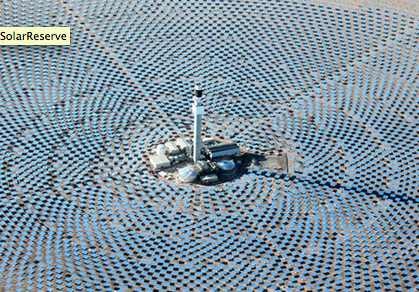
Biggest solar tower storage plant starts commissioning


crescent dunes solar tower storage
As Ivanpah, the world’s biggest solar tower power plant comes on line, commissioning has begun on Crescent Dunes, the world’s biggest solar tower power plant that incorporates storage.
The 110MW Crescent Dunes project near Tonopah. Nevada, is 5 times bigger that other pilot and demonstration projects that have tested molten salt technology, and the first at what is regarded as “utility scale.”
Screen Shot 2013-07-04 at 8.53.00 AMThe plant has been built by California-based Solar Reserve, which recently opened an office in Western Australia, and the storage capability means that it will have twice the output per MW of other solar technologies.
It also means that it can deliver electricity when needed. It has a contract to deliver electricity to Las Vegas between the hours of noon and midnight. As this graph shows, it can deliver its output in blocks, if needed, rather than the variable curves featured of solar technologies without storage.
The storage technology also eliminates the need for any backup fossil fuels, such as natural gas.
Solar Reserve says the commissioning is the initial stage of bringing the project into operations and includes system-by-system verification and startup, as well as equipment calibration and testing.
This includes “energization” of the utility interconnection system and other electrical systems, and testing and calibration of the heliostat field, which comprises more than 10,000 “billboard-sized” mirrors that track the sun and total more than 1 million square meters of glass.
Commissioning also includes systems unique to Crescent Dunes such as a Heliostat Field Control System that will control and concentrate the sun’s energy and also the Molten Salt System that will harness, store and transform the sun’s energy into superheated steam, making this the most advanced solar power plant in the world.
The facility also includes a dry cooled condenser in a hybrid configuration to minimize water use to levels well below that of conventional power plants.
“Start of commissioning of the Crescent Dunes solar power plant marks a critical milestone for the project as well as the solar industry,” CEO Kevin Smith said in a statement. “We are now able to build utility-scale power plants, fueled only by the sun, which operate on-demand, day and night, just like traditional fossil fuel or nuclear power plants.
SolarReserve’s industry-leading solar thermal energy storage technology solves the intermittency issue that limits the use of other renewable energy projects and thus enables firm, reliable delivery of electricity whether or not the sun is shining or the wind is blowing.”
Abengoa is also looking to build a 110MW solar tower plant with 17 hours of storage in Chile.

Tuesday, January 28, 2014

flowbatt
The new flow battery design from a Harvard team uses organic (carbon-based) materials instead of a rare metal. Eliza Grinnell/ Harvard School of Engineering and Applied Sciences
A new kind of battery designed by Harvard University scientists and engineers could unlock the potential of renewable energy sources like wind and solar.
One of the problems with solar and wind power is that the flow of electricity can’t be constant – the sun sets or goes behind clouds, and the wind dies or picks up. This can cause problems if these systems are wired into the electric grid, which has trouble handling sudden massive surges and dips in demand (Hawaii and Germany are two areas where this problem has already begun to butt up against widespread solar panel adoption). Having a reliable, cheaper way of storing massive amounts of electricity would be a big step towards wider reliance on these alternative energy sources.
In a paper published in the journal Nature on Wednesday, Harvard chemist Roy Gordon and colleagues described their design for a special kind of battery that might fit the bill. The team’s current model is just a laboratory experiment for now, but they think it could be scaled up to store large amounts of energy, providing the buffer that the grid needs to handle excess energy pouring in from solar panels and wind turbines. And the central ingredient of the battery is relatively cheap, which means it may move to market quicker.

Sunday, December 1, 2013


Catching solar energy with salt balls 


A pedestrian exercises on the Venetian Causeway, which connects Miami and Miami Beach. When it comes to solar power, Florida remains a laggard, trailing not-so-sunny places such as New Jersey and Massachusetts. (ANGEL VALENTIN/The New York Times)


To Florida’s big utilities, the Sunshine State isn’t as bright as its nickname indicates.
Too cloudy. Too hazy. Too much darkness. It just doesn’t have the pounding rays of, say, Arizona or parts of California.
As such, the reasoning goes, the Sort of Sunny State isn’t great for solar energy – unless someone develops storage technology to overcome those limitations.

His solution: salt-filled ceramic balls that can turn water into steam for hours after the sun disappears. The steam powers turbines that produce electricity, in much the same way as burning coal.
Enter Yogi Goswami, an internationally renowned mechanical engineer at the University of South Florida.
Dr. Goswami, 65, isn’t the only researcher to develop a solar thermal storage technology for renewable energies. And he’s not the only one to use salt as a main component.
But he has devised a way to concentrate the energy storage into golf ball-size capsules that even at high volumes take up little space, reduce costs and last longer than other technologies so far.
“We think that this has a bright future,” Dr. Goswami says. “For solar, in my view, [storage] is essential.”
Storing power
In the renewable energy world, building a cost-effective, utility-scale system that can store solar power for hours at a time is a Holy Grail of sorts.
“That will be a game changer,” Duke Energy Florida president R. Alexander “Alex” Glenn told state lawmakers last spring. “Storage is going to be critical.”
A race is on to develop the best technology. A few systems are already in use or being tested.
Duke Energy for instance operates one of the nation’s largest storage technologies at its Notrees Battery Storage Project that uses lead-acid battery blocks at a wind farm in Texas.
Arizona’s Solana Generating Station already uses a salt-based storage system that powers two 140-megawatt turbines that generate electricity for as long as six hours after sunset. The system produces enough power for 70,000 Arizona Public Service customers.

Vanderbilt Proposes Building Energy Storage Into Solar Cells

Thursday, November 28, 2013

Renewable energy storage device developed 

at Muskegon's GVSU business incubator  

MUSKEGON, MI – Grand Valley State University’s Michigan Alternative and Renewable Energy Center has launched a number of upstart businesses, but breakthrough products have been few and far between.
Energy Partners LLC founder and GVSU professor emeritus Jim Wolter thinks he and partner Ed Brandel have come upon an energy storage device that could be a game changer.
Solar24.JPGSolar 24 combines a large solar energy panel with a battery pack and electronic circuits to provide a steady stream of energy whether the sun is shining or not.
Energy Partners – a three-year research and development venture that has made the MAREC business incubator its home – introduced Solar 24 at the Solar Power International Conference in Chicago at the end of October.
The energy storage device allows for the steady discharge of electricity created by solar panels over the course of a day even during nighttime hours, Wolter said. Besides technical support from MAREC, Solar 24 received funding from the Michigan-based Business Accelerator Fund.
“This is breakthrough technology,” said Arn Boezaart, director of the Muskegon-based MAREC. “It’s the first of its kind that I’ve seen in the renewable energy industry and addresses the often-cited intermittent nature of solar energy. This kind of innovation is the reason MAREC’s business incubator program provides the resources and space to develop new products and concepts.”
The “secret sauce” is in the electronic circuits that Brandel brought to Energy Partners, Wolter said, adding that patents are pending. The Muskegon native is a Texas Tech University engineering graduate who worked for Texas Instruments in Lubbuck, Texas as an electrical engineer.
Brandel worked in the areas of consumer products, semi-conductors and microprocessors before returning to Muskegon, he said. Wolter and Brandel have been working together on the Solar 24 for the past year and a half.
“The circuitry controls how much power you take out of the device,” explained Wolter, a retired professor of both engineering and marketing who has specialized in bringing new technologies to market.