Showing posts with label solar rooftop. Show all posts

Wednesday, March 26, 2014

Fight over Rooftop Solar Forecasts a Bright Future for Cleaner Energy

As the cost of solar power drops, more consumers find that they hold the upper hand as utilities fight to maintain paying customers and the relevance of the grid
solar-rooftop


SOLAR ROOF: As photovoltaics on rooftops become more affordable, they have become more and more of a threat to traditional electric utilities.
Courtesy of U.S. Department of Energy
Americans have begun to battle over sunshine. In sun-scorched Arizona a regulatory skirmish has broken out over arrays of blue-black silicon panels on rooftops, threatening the local utilities that have ruled electricity generation for a century or more. With some of the best access to sunshine on the planet, Arizona boasts the second-most solar power in the U.S.—more than 1,000 megawatts and counting. The state hosts vast photovoltaic arrays in the desert as well as the nation's first commercial power plant with the technology to use sunshine at night—bystoring daytime heat in molten salts.

In terms of infrastructure, such big solar fits as comfortably as a coal-fired power plant in the traditional electricity business model, which involves large plants transmitting electricity over a grid of conducting lines through transformers and into individual homes and businesses. The trouble, from an electric utility's perspective, is the tens of thousands of Arizona's total of three million or so homes that have installed small solar:photovoltaic panels made from wafers of semiconducting material, typically silicon, that use incoming sunlight to create an electric current. With these homes making their own electricity, utilities lose their most lucrative customers and confront a dwindling base over which to spread big infrastructure costs, like building new power plants or maintaining the grid. "The net-metered customer does not share equally in the overhead costs associated with the grid or other services provided by the utility, producing a very substantial 'cross-subsidy' funded by all other utility customers who must pay proportionately more," wrote James Hughes, CEO of solar panel maker First Solar, in an op-ed in support of the utility Arizona Public Service Co. (APS) position this past June.

These homeowners have installed photovoltaic panels on their rooftops with the help of cash incentives and a state law that requires the local electricity provider—APS—to buy any excess power produced by an individual home. Such "net metering" programs allow homeowners to zero out monthly or even annual electric bills. That means APS gets nothing from these former customers, and their number is growing. More than 15 rooftop arrays go onto Arizona homes each day, according to the Phoenix-area utility, and the number of such solar independents grew from 4,770 in 2010 to 14,524 in 2012.

In response APS and other utility companies across the country have launched a propaganda war against an energy source that still accounts for less than one quarter of 1 percent of U.S. electricity. In Arizona that fight became very public in 2013, as APS took on such residential solar power in a television ad campaign and mailings. But the utility met resistance from a coalition of liberals and libertarians decrying monopoly or wanting to help cut greenhouse gas pollution. The red on the map that shows the amount of incoming sunshine available in most of Arizona might just as well stand for the bad blood spilled between solar homeowners and the local utilities.

It's not just Arizona. More than 40 states allow property owners to sell excess energy generated by solar panels onto the electric grid, and many utilities must pay a premium for this resource. Utility companies warn that the lost revenue from solar-powered costumers will necessitate price increases for people without solar panels, because the electric grid and other critical infrastructure must still be maintained. That’s a sticking point for residents like Alicia Roll in Phoenix, who wrote in hercomplaint to the state: "I'm all for helping preserve the environment but there must be a fairer way of going about it all."

Sunday, December 1, 2013

ROOFTOP SOLAR CAN REDUCE SUMMER PEAK Electricity Demand By More Than 50 Percent

BY MARI HERNANDEZ, GUEST BLOGGER ON NOVEMBER 24, 2013 AT 12:24 PM
shutterstock_117620479
CREDIT: SHUTTERSTOCK
new study by the Pecan Street Research Institute found that residential solar panel systems can cut electricity demand during peak summer hours by 58 percent.
The study used data gathered from Pecan Street’s demonstration project — an innovative living test lab that allows the research institute to provide original research on customer energy use, renewable energy integration and smart grid technology.
By monitoring 50 single-family homes in Austin, Texas with west- and/or south-facing solar panels from June through August this year, the study found that west-facing solar panels produced 49 percent more electricity during summer peak demand hours than south-facing panels, a finding that should make utilities think twice about excluding west-facing solar panel systems from solar rebate programs. According to the study, west-facing rooftop systems cut peak demand 65 percent, while south-facing systems reduced peak demand 54 percent.
Though west-facing systems may be better at cutting summer peak demand and add more value to the grid in certain regions, south-facing systems still have an advantage in total annual energy production — an important distinction mentioned in the report.
The Pecan Street study also looked at how much solar power was being used in the homes versus being returned to the grid. It found that during peak hours, homes used 80 percent of the solar power generated on-site, while just 20 percent was sent back to the grid. Over the course of a full day, 64 percent of the solar power generated on-site was used in the home.

Monday, February 18, 2013


Macquarie says rooftop solar juggernaut is unstoppable


In an analysis that broadly reflects the conclusion of UBS energy analysts about how rooftop solar PV is heralding an energy revolution, Macquarie notes that many existing fossil fuel generators in Germany are losing money and could go out of business. And even steep subsidy cuts to renewables would not reverse the trend.The fundamental transformation of energy markets brought about by the growing incursions of renewables such as wind and solar has been underlined in a new report by the European energy analysts at Macquarie Group, who have concluded that the plunge in costs for rooftop solar PV has fallen to such an extent that its continued rapid deployment may be unstoppable.

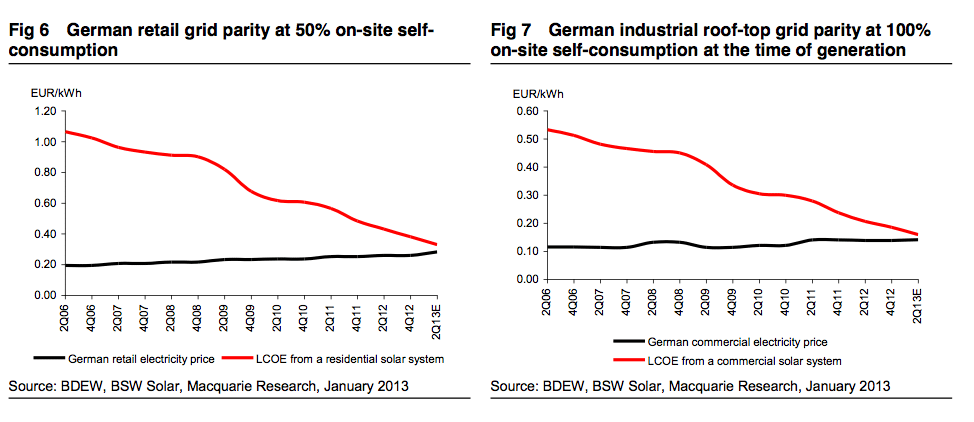
“Traditional wisdom suggests that steep subsidy cuts can bring the solar build-out under control again,” the Macquarie analysts note. “We disagree, though, as the ever-increasing prices for domestic and commercial customers as well as rapid solar cost declines have brought on the advent of grid parity for German roofs. Thus, solar installations could continue at a torrid pace.”
Here are some key graphs to illustrate its point. Macquarie notes that wholesale prices in Germany have fallen 29 per cent over the last five years, while retail prices have risen 31 per cent – both movements at least partly due to the impact of renewables. But those movements pale in comparison with the dramatic fall in the cost of rooftop solar PV.
(If the graph is partly hidden in your browser, please click it to see it in full).
Screen Shot 2013-02-12 at 8.51.46 AM
Macquarie says rooftop solar generation in Germany currently costs between €0.12kWh and €0.14/kWh (assuming 85 per cent debt financing and 4 per cent interest rate). These compare favourably with retail grid electricity prices of €0.28/kWh (even at just 50 per cent on-site self-consumption). But solar PV can even offer savings at industrial and commercial grid prices which are even lower at €0.11-0.17/kWh.
“Consequently, solar installations could continue at a rapid pace even without subsidies,” Macquarie notes. “Ultimately, this would threaten the role of coal-fired generation as the price setter in wholesale power price formation.”

Wednesday, February 6, 2013


Bobby Kennedy: We should have solar on every rooftop

by Giles Parkinson

In inviting Robert F. Kennedy Jr to become a director of its board, Australian renewable energy minnow CBD Energy has not only acquired a famous family name, it has also brought in one of the most committed environmental campaigners in the world, with a no-holds-barred approach to combating the immensely powerful fossil fuel industry, fighting pollution and promoting wind and solar.
In an exclusive interview with RenewEconomy in January – click here for the full transcript – Bobby Kennedy says the global energy system has been corrupted by the absolute power of immensely wealthy oil and coal companies, and the main hope to combat this is by “democratising” the energy industry through individual production, such as rooftop solar.
“The rules by which energy is regulated were written to favour the most poisonous, destructive and addictive fuels from hell, rather than cheap, clean, green, safe, abundant and patriotic fuels from heaven,” he told RenewEconomy. “We need to reverse that dynamic, it’s in our national interest to do so – of Australia and the US. It’s in the global interest of humanity to do so. We’re on a trajectory to a place where we are creating a planet that is a science fiction nightmare.”
bobby kennedy
Bobby Kennedy says the wealth and dominance built up by the fossil fuel industry over the past few decades, supported by huge and continuing subsidies, has not only corrupted the energy system, but the political one too.

“Wherever you see large-scale pollution, you will also see the subversion of democracy, you will see the compromise of public officials, the capture of the agencies they are supposed to protect; they become sock puppets of the industries they are supposed to regulate. You see that in the political system, the kowtowing  of the politicians who become indentured servants in the US and in Canada."
Now, he says, technology and costs of renewables – solar PV, in particular – has moved to the point where this stranglehold can be relaxed, or even released. This is part of the reason why Kennedy recently joined with David Crane, the CEO of US generation giant NRG, to push for the installation of rooftop solar in every household in the country.
In a joint opinion piece published in December in the New York Times, Kennedy and Crane said solar PV would "significantly reduce our reliance on fossil fuels and our dependence on the grid.”

Saturday, December 15, 2012


US Rooftop Solar Boom Will Help SunPower

 by Trefis Team

According to a report by the Solar Energy Industries Association (SEIA), a solar industry trade group, photovoltaics installations in the United States grew by 44% in Q3 compared to last year driven by strong sales of rooftop systems as falling prices and attractive financing options are making solar power more accessible for customers. [1] We believe that the strong momentum in the US rooftop solar space will be beneficial to SunPower (NASDAQ:SPWR), one of the world’s largest monocrystalline solar panel manufacturers.
Strong Rooftop Market Growth Will Benefit SunPower
The residential market witnessed a quarterly record high of 118 MW of solar panels being installed, growing 12% sequentially while commercial installations came in at 257 MW, displaying 24% sequential growth. However, prices continued to decline with average prices for residential system falling by about 5% sequentially to $5.21/watt while non-residential systems witnessed a decline of about 4% to $4.18/watt.
Although the residential solar market remains relatively small in comparison to the overall solar market, it is important for solar manufacturers since it exhibits the most consistent growth and provides more stable revenues compared to the utility and commercial segment which are driven by larger contracts. The residential space is also an important market for higher end solar products.
Residential and commercial installations account for more than half of SunPower’s Trefis price. Residential and commercial installations are primarily done on rooftops, calling for panels that are compact, aesthetically pleasing and high in conversion efficiency. (Also See: A Comparison of Solar Technologies And What They Mean For Companies) SunPower has typically enjoyed an advantage in the US rooftop space thanks to its high efficiency monocrystalline panels, some of which offer efficiencies of above 20%. These panels also offer higher durability and a longer life compared to competing thin film and monocrystalline panels.

Rooftop solar is actually saving Queensland householders money

by John Davidson

A power company rang me up last week offering to increase my rooftop solar (RTS) feed-in tariff if I switched my contract to them. My first thought was that this was a marketing ploy but, on reflection, this did not make sense. Why would a power company want a customer who produces about as much power as the household consumes?
By contrast, others are claiming that ordinary householders are subsidising rich rooftop solar owners. For example, Mark McArdle, (Queensland Minister for Energy and Water Supply) issued a media statement saying “the QCA analysis showed the solar bonus scheme currently added $26 per year to everyone’s annual electricity bill, which will increase to $90 next year if an application by Energex to the Australian Energy Regulator was successful.”
He added, “Rooftop solar costs are projected to add more than $240 per year to average electricity bills within five years.” (These claims were based on the previous government’s feed in tariff of 44¢/kWh)
If rooftop solar really was driving up household bills, a power company that was paying a premium to buy more rooftop solar power would have to increase their charges to pay for this premium. Not an aid to competing in a cutthroat market.
So what is rooftop solar actually doing to household power bills in Queensland? And how high could the feed-in tariff go before it really would be increasing household power bills?
In the detailed section below, a comparison of demand and revenue vs time of day for 2008 and 2012 is used to answer the above questions. The quick answers are:
1. Rooftop solar is actually saving the “typical Queensland household” (without PV) $65/yr.
2. The feed-in tariff would have to rise above 96¢/kWh before rooftop solar actually stopped saving households (and power companies) money. Power companies can actually become more competitive by locking in extra contracts for the supply of rooftop solar, even if it means paying the small premium that was offered to me.
3. It is difficult to say what effect rooftop solar would have on household bills in five years' time. My guess is that investment in rooftop solar will be justified at feed-in tariffs below what householders will be paying for power and that it will still be saving households money.

Wednesday, November 7, 2012


Thursday, September 20, 2012

Business Line : Industry & Economy News : Rooftop solar will be the next big thing, say experts

Rooftop solar power plants are set to take off in a big way in India, many speakers at REaction, a conference of the renewable energy industry here, said. The 3-day conference is being organised by Energy Alternatives India, a Chennai-based clean-tech consultancy.
Mr Pashupathy Gopalan, Managing Director, SunEdison, said solar plants on rooftops of commercial buildings can even now produce power at costs almost equal to distribution company rates.
Residential rooftops will reach “grid parity” within two years, he said.
It doesn’t matter even if policy-makers do nothing to push rooftop solar. “Economics will take over,” Mr Gopalan said.


Govt plans 'Rooftop' solar power policy
BS Reporter / Mumbai/ Ahmedabad Apr 20, 2012, 00:22 IST

After dedicating to the nation 600 megawatts (Mw) of solar power projects in different parts of Gujarat, state chief minister Narendra Modi on Thursday hinted to come out with a rooftop solar power plant policy to encourage people to produce their own electricity and earn by selling the surplus power to the state grid.
At a function to mark the opening of the Gujarat Solar Park at village Charanka of Patan district on Thursday, Modi mentioned that the said policy would make the people self-reliant in power generation. This would also encourage them to lease out their roof tops for solar power generation, which would yield additional income for the betterment of their life.


Twenty-two teams from across the country are taking the Rooftop Solar Challenge to make installing rooftop solar photovoltaics (PV) easier, faster, and cheaper for homeowners and businesses. With support from the U.S. Department of Energy (DOE), these collaborative teams are implementing streamlined and standardized processes that will dramatically improve local market conditions. The Challenge is part of the DOE SunShot Initiative, which seeks to make solar electricity cost competitive without subsidies by the end of the decade. More information
KPMG says rooftop solar power could be a game-changer for India

Rapid fall in solar prices and increase in cost of conventional power driven by fuel shortages has brought 'grid-parity' closer, which is expected to happen at a broad scale level by 2017 in India, according to the report,KPMG said in a report.
KPMG sees India's cumulative solar photovoltaic market potential by 2016-17 at around 12,500 megawatts, which would include around 4,000 mw of rooftop market.
Business Line : Opinion : Solar power on every rooftop

A solar panel atop every house should be the model for providing electricity to all. The grid should merely serve as a back-up.
With will and vision, India’s energy prospects can be changed from grim to green, and the world will benefit as a result.
The failure of the country’s electricity grid on July 30 and 31 highlights its vulnerabilities and underscores a larger national need: about 400 million Indians are not connected to the grid at all, and those who are have unreliable access. At 571 kWh per capita, India’s electricity consumption is one-fifth of China’s (2,631 kWh) and less than one-twentieth of the US’ (12,914 kWh). India’s electricity demand will only grow.
Burning coal for electricity is increasingly expensive, causes global warming, and jeopardises the planet’s health. In any case, India has ash-rich coal, limited oil, unknown amounts of gas, poor mining productivity and inadequate transport. Power plants struggle to get reliable fuel supplies. Solar electricity today at Rs 7.50 a kWh is economical compared with subsidised diesel-generated power at roughly Rs 15 a unit, but more expensive than coal-based electricity at about Rs 6. What, however, is the true cost of coal-based power? Prices are distorted by subsidies, State boundaries, vote-bank politics, and uncharged carbon-emission costs. Average prices matter less than peak prices. When India sheds load to manage peaks, customers use expensive diesel power.

Friday, September 14, 2012


$10 Million SunShot prize for cheap rooftop solar

by Tina Casey

The U.S. Department of Energy’s SunShot program has just kicked off a new round in a $10 million solar power competition designed to lower the cost of solar power, pretty much down to where a small rooftop solar installation could be a reasonable investment for practically anyone in the country.
If you’re thinking that means building a better solar cell, that’s not it. Instead, the Most Affordable Rooftop Solar Prize is aimed at encouraging the solar industry to figure out ways to lower the “soft costs” of solar power.
Hard Cost of Solar Going Down…
Overall, the Department of Energy estimates that the cost of solar cells and other hardware has dropped by a whopping 400% in the past four years. Even more savings are in store as newhigh-efficiency solar innovations come on line, along with new low-cost solar cell manufacturing processes.

…But Soft Cost of Solar Stays Up

The sticky wicket has been soft costs, in the form of licenses and permits, installation procedures such as connecting to the grid, and routine maintenance. Those typically account for more than half the cost of a small-scale rooftop solar installation (and why solar is almost twice as cheap in Germany as it is here in the U.S.).
Cutting soft costs might seem relatively easy compared to coming up with the next cutting-edge solar cell breakthrough, but according to the DOE, soft costs have remained “stubbornly high.”

Wednesday, September 12, 2012


Rooftop Revolution: New book aims to combat King CONG

by Joshua Hill

One of the planet’s leading clean-tech entrepreneur’s, Danny Kennedy, has launched a new book that hopes to debunk myths surrounding the solar industry, and unveil some simple methods that the public alongside policymakers can use to help generate positive change in the energy industry.
The book, Rooftop Revolution: How Solar Power Can Save Our Economy – and Our Planet – from Dirty Energy, available in both electric and print versions, contains a forward by the former supreme commander of NATO, General Wesley Clark, and is based on Kennedy’s front-line experience and objective research, as it lays out the author’s belief in a win-win scenario for implementing solar energy throughout the United States.
“Solar energy isn’t a left or right issue: it’s an economic one, and it should be a central part of the election cycle dialogue on how to fix our economy,” says Kennedy. “There is in fact a clear economic imperative for clean energy now, and despite myths and misperceptions, solar power is already at work creating jobs, saving American households on their utility costs and securing both our workforce and our borders from the ills of dirty energy.
“The sun’s reliability, coupled with recent manufacturing efficiencies in our industry, make solar energy a more affordable, cleaner and safer way to power our lives. It’s not the energy source of the future, it’s the energy source of now.”


Power price pain driving ‘ditch the grid’ mentality, says CBD Solar

by Sophie Vorrath

We know that more and more Australians are taking up rooftop solar in an effort to counter rising electricity bills – last year, households around the nation installed more rooftop solar than Germany, the world’s solar leader – but could rising power prices also be driving them to look for an alternative to grid connection?
Yes, says CBD Solar manager, Jeff Bye, who argues that, with power companies said to be “gold plating” networks by over-investing in poles and wires, more people are looking for answers on how to “ditch the grid” entirely – a move that could be achieved through a combination of solar power and energy storage.
“If people install solar panels and battery storage, they only need the grid as a backup supply,” Bye said in a statement released today.
“Improvements in technology, being driven by the auto industry, are leading to more efficient and effective battery storage which works well with what can be intermittent production of electricity from solar power,” Bye said.
According to CBD Solar, the average cost of energy is now between 20 and 30 cents a kilowatt hour, reaching 43 cents at peak – and according to Treasury estimates, some 51 per cent of this cost is from network and distribution costs.
Solar energy, meanwhile, costs between 5 and 7 cents a kilowatt hour to produce – a level that is applicable over the lifetime of a solar system of around 25 years.

Tuesday, August 14, 2012


Rooftop solar panels: our new peaking power generators

by Giles Parkinson

Demand management has finally entered the political lexicon, as politicians to the left and the right realise that a 20-lane wide power grid has been built to service our energy demands, when one half that size might just as easily fit the bill.
Politicians are reacting because the increasing cost to consumers is finally being passed on to the ruling class in the form of a cost to their political capital. But amid the name-calling, the blame-gaming, the party one liners, and the ducking and weaving, comes the realisation that there are some seriously good alternatives. But what is not widely accepted is that many of these solutions involve renewables.
The common thinking among many energy experts and energy ingĂ©nues is that renewables such as wind and solar are intermittent and unreliable, and therefore cannot be relied upon for “baseload” generation, let alone switched on at will to meet the rising peaks.
The CSIRO would like to differ. In fact, says Glenn Platt, the head of the local energy systems team, distributed generation such as tri-generation and co-generation, but also in the form of rooftop solar, can play a crucial part in meeting peaking demand. Far from contributing to the problem, renewables such as solar can be harnessed to provide a solution.

Monday, August 6, 2012


City of Sydney signs contract for 1.25MW of rooftop solar

by Giles Parkinson

The City of Sydney has laid claim to the country’s largest rooftop solar installation after announcing plans to install a 1,250kWp (kilowatt peak) system across 30 sites within its boundaries over the next two years.
The City said Solgen Energy had won a $6 million contract to install solar photovoltaic panels, which it said would generate around 2 million kWh of electricity a year and provide 12.5 per cent of the electricity needs of its city properties. It said it would reduce 2,100 tonnes of CO2 emissions a year at an abatement cost of around $33/tonne, and would meet half of the targeted 8 per cent emissions reductions by 2030 from the development of solar.
Solgen beat off rival bids from Ingenero, NU Energy, RF Industries and SunPower, although a second tender was called after it was realised that solar PV prices had fallen so quickly that the city could easily beat its original deployment targets of between 800kWp and 1,000kWp.
The panels will be installed on buildings such as Town Hall House, the Redfern Oval grandstand, the Railway Square Bus Interchange, Sydney Park Pavilion, towns halls in Paddington, Redfern and Glebe, as well as libraries, community centres and council depots.
The solar energy will be augmented by the City’s plan to invest in trigeneration systems and fuel cells, further reducing its reliance on the grid, and avoiding the need for new coal-fired generation and network upgrades. It aims to source 30 per cent of its electricity from renewables by 2030, and 70 per cent from cogen and trigen plants.

Wednesday, August 1, 2012

Rooftops Provide Huge Opportunity For Solar Development
Los Angeles is a prime area for solar power, and its development space is growing. More than 12,000 acres are available on rooftops across the city, which could net families and business owners up to five gigawatts of power. This clean energy reduces oil dependency, helps the environment, and over time cuts energy costs. This broad new opportunity provides the perfect time for solar training. Staying abreast of this exciting development in Los Angeles will provide many benefits.

Onsite solar training provides crucial details for making decisions about solar development. Los Angeles aims to fill a third of its energy needs through renewable sources by 2020. 
Solar courses are a unique opportunity to join in this growing technological market. With free solar training available in some areas, anyone can decide whether renewable energy industries are a good next step, even enrolling in a solar training institute for advanced study.

Solar energy is one of the cleanest and most sustainable forms of energy currently available. With so much sun hitting Los Angeles daily, it is an obvious choice for solar development. 
Solar training makes sense for anyone interested in green energy and the technological future of Los Angeles. Students can take advantage of free solar training to further their education. Professionals may choose a solar training institute to build their resume or boost their career.

Monday, July 23, 2012


Over 750,000 homes in Australia now have rooftop solar

by Ray Wills

The latest data from the Australian Clean Energy Regulator shows that more than 750 000 homes in Australia are now equipped with solar PV panels totalling almost 1.7 GW of installed capacity says the Sustainable Energy Association of Australia (SEA).
With 8 million homes in Australia and existing growth trends, more than 10% of homes will have installed solar panels within the next couple of months.
Figure 1. Cumulative number of solar panels (as measured by SGUs).
Installation rate of solar has slowed slightly from 2011 when more than 860 MW of solar PV was installed, but based on current trends an additional 600 MW of small scale solar capacity is likely to be added in 2012.
Figure 2. Cumulative capacity of solar panels (kw - as measured by SGUs).
Forecasting installation rates forward, Australia is likely to have a million homes with solar in around 12 months time, bringing installed capacity of small scale solar to over 2.3 GW.
Average system size continues to grow, with systems recorded for June 2012 averaging 2.84 kw, but with changes in feed in tariffs occurring around Australia, this trend looks set to reverse.

Tuesday, May 29, 2012


Rooftop solar PV to be energy game-changer in Australia

In a report entitled Rooftop PV Information Paper, AEMO says that up to 18,000MW of solar PV could be installed on Australian rooftops by 2031 – under its high growth scenario – when it could potentially account for around 10 per cent of the electricity produced in the country. Even its mediums scenario predicts 12,000MW of rooftop PV.The Australian Energy Market Operator has produced a landmark report that for the first time recognises rooftop solar PV as a significant source of energy in the National Electricity Market, and includes forecasts that could have a profound impact on the way electricity is consumed and produced – and talked about – in this country.
The forecast by AEMO is the first formal recognition by an Australian energy authority of the potential of rooftop solar in Australia – something that had remained the province of the solar industry itself, a handful of consultants, the Greens, advocacy groups, and web sites such as this.
The report is in marked contrast to the Draft Energy White Paper produced for and released by Federal Energy Minister Martin Ferguson last December, which predicted that solar – in all forms, including utility scale solar PV and solar thermal – would account for less than 3 per cent of Australia’s electricity capacity  by 2030, or 2,000MW in all forms.